Bobby Sheehan (1949–2026): "Moses" — The 2 A.M. Call-Up Who Carried the '79 Rangers

Updated: 4 hours ago

The phone rang at 2 A.M., and 2 A.M. phone calls are never about anything good. Bobby Sheehan was asleep in Connecticut, coming off a season with the New Haven Nighthawks — 33 goals, 48 assists, 81 points, a spot on the AHL's Second All-Star Team — without playing a single regular-season game for the big club. On the other end of the line was his coach, Parker MacDonald, delivering the sentence every minor leaguer plays his whole career hoping to hear in his sleep: "You're going up to the Rangers. You have to be in Philly tomorrow."
His wife didn't believe it. Sheehan did — eventually — and he grabbed his equipment and drove to Philadelphia in such a state that, as he told me years later, "I went over the bridge twice." He arrived as the Rangers were coming off the ice from practice, and the players — men, professionals, a team that had just lost Game 1 of its playoff series — got down on their knees in front of a 5-foot-7 minor leaguer and begged: "Moses, we need help." His boyhood nickname was "Cat" — the guys called him "Shecat" — but in that room, in that moment, he was the man sent to lead them out of the desert.
His first practice, he wore an oversized jersey with no name on the back, and by his own admission he was nervous. You would be too. What followed was five weeks nobody at the Garden has forgotten.
Bobby Sheehan died Saturday at his home in Massachusetts, surrounded by his family. The Rangers, in their statement, said he "played an integral role in helping the Rangers advance to the Stanley Cup Final in 1979." That is true, and it is also a huge understatement. For 15 games, a man who never played one regular-season shift for the New York Rangers became the most unlikely hero of the most unlikely playoff run in franchise history.
Bobby Sheehan came out of Weymouth, Massachusetts, a town that makes workingmen, and he played like one. Sheehan was a little guy in a big man's game — 5-foot-7, about 155 pounds, a left-shooting center — and he was something else unusual for his era: an American in a league that still treated American-born players as a rumor. Montreal drafted him 32nd overall in 1969, and two years later the kid from Weymouth was a Stanley Cup champion, skating in six playoff games for the 1971 Canadiens. Most players would frame the photo and call it a career.
His best NHL season came with the California Golden Seals in 1971–72 — 20 goals, 46 points — which was a little like being named valedictorian of summer school. Then came the wandering years in the WHA: the New York Raiders, the Golden Blades, the Jersey Knights, Edmonton, Indianapolis — 241 games and 185 points in the rebel league, in arenas where the ice was sometimes the most stable thing in the building. There were NHL stops in Chicago and Detroit, too. If a franchise owned a duffel bag in the 1970s, Bobby Sheehan had probably carried it.
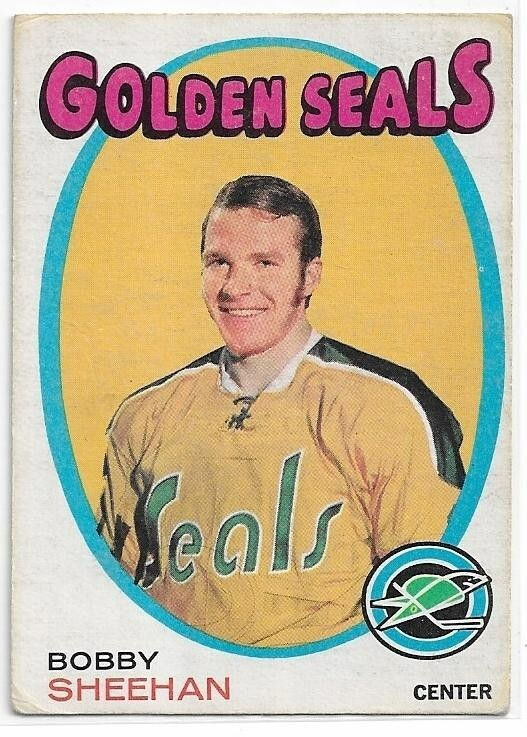
On October 1, 1978, the Rangers signed him as a free agent and sent him to New Haven, where he spent the entire season doing everything a player can do except get called up. And he waited. Then the Rangers lost Game 1 of the quarterfinal to Philadelphia, Fred Shero reached for the phone in the middle of the night, and the waiting was over.
Sheehan stepped in at center between Pat Hickey and Ron Duguay and never came out — all 15 playoff games. He scored his first NHL playoff goal in Game 4 against the Flyers, and the Rangers put Philadelphia away in five. The little call-up wasn't a mascot. He was a difference-maker.
Then came the semifinal against the Islanders, the powerhouse from Nassau, and Sheehan scored in Game 1. He scored in Game 2. He scored in Game 3. The Rangers took the series in six, in one of the great upsets the Garden has ever hosted, and when I asked him about it decades later, he reached for the only words that fit: "It was just like I was reborn again."

The Final took him full circle, back to Montreal — his first team, the team of his Stanley Cup ring. He picked up an assist, and the Rangers fell in five to a Canadiens club that was simply better. His linemate Ron Duguay, all hair and speed, died just last month, and every time one of these names crosses the wire the '79 team gets a little smaller and the spring gets a little farther away. It deserves to be remembered exactly as loud as it was.
Fred Shero, famously, was not a man who wasted words on his players, and he barely spoke to Sheehan at all. But one night in Philadelphia, with Sheehan sitting in the penalty box, Shero called for him — and Phil Esposito had to explain, in so many words: Freddy, the Cat's in the box. Later, Esposito told Sheehan that Shero had called him one of his favorite players. Sheehan laughed when he told me that one. "I was only up there for a cup of coffee," he said. "I'll take that accolade."
He had opinions, too — he told me he always thought Nick Fotiu should have dressed against Montreal, that the Canadiens series needed a little more muscle in the corners. And his favorite memory of the whole run wasn't a goal. It was the night a Flyer drove him into the corner and he braced for the worst, and the entire Rangers bench came over the boards to save him. For a 5-foot-7 call-up, that's the review that matters: the big guys came for him.
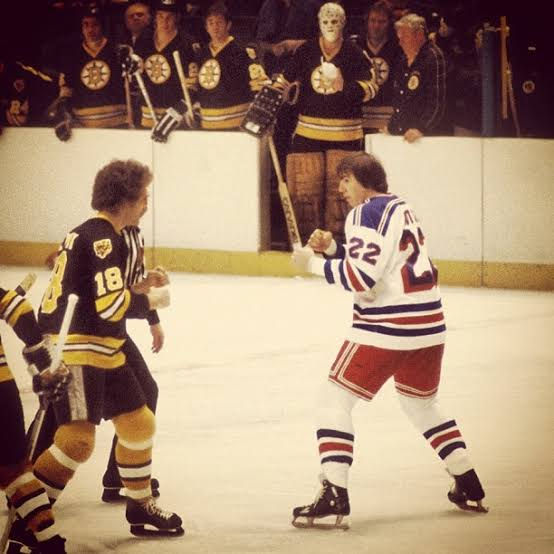
I interviewed Bobby Sheehan because when I was writing Before '94, with Howie Karpin, about those '79 Rangers, I was stubborn about one thing: I was going to track down every single guy from that team. The stars are easy to find. Bobby take some hunting. Every player I reached before him said the same thing — make sure you say hello to the Shecat for us. What I found was a man with not one drop of bitterness in him — a guy fate had handed fifteen games, and who had spent forty years grateful for every one of them.
The Rangers didn't keep him — hockey is a business, and sometimes it's a dumb one. He went to Colorado, played four games for Los Angeles, finished up in the minors at Binghamton, and hung up the skates in 1983 with 310 NHL games, 48 goals and 111 points on the ledger. None of those numbers is the point. "I was happy enough to be called up," he told me. "That was good enough for me."

After hockey, he worked 31 years as an investigator for the Massachusetts State Lottery — the night shift, riding herd on bingo halls, making sure nobody stole the money. A Boston Hall of Famer helped him land the job, and Sheehan, loyal to the last, would never tell me the man's name. I teased him once — it wouldn't be number four or number seven, would it? He just laughed. Some assists, he understood, never make the scoresheet.
A Funeral Mass will be celebrated Thursday at Immaculate Conception Church in East Weymouth — back home, where the whole story started. The '79 Rangers have lost their Moses. But somewhere in the memory of every Rangers fan who lived through that spring, a phone is ringing at 2 A.M., a little guy is crossing a bridge twice because he can't wait to get there, and a whole team is on its knees, asking him to lead them out. He did. Rest easy, Cat.


Comments